
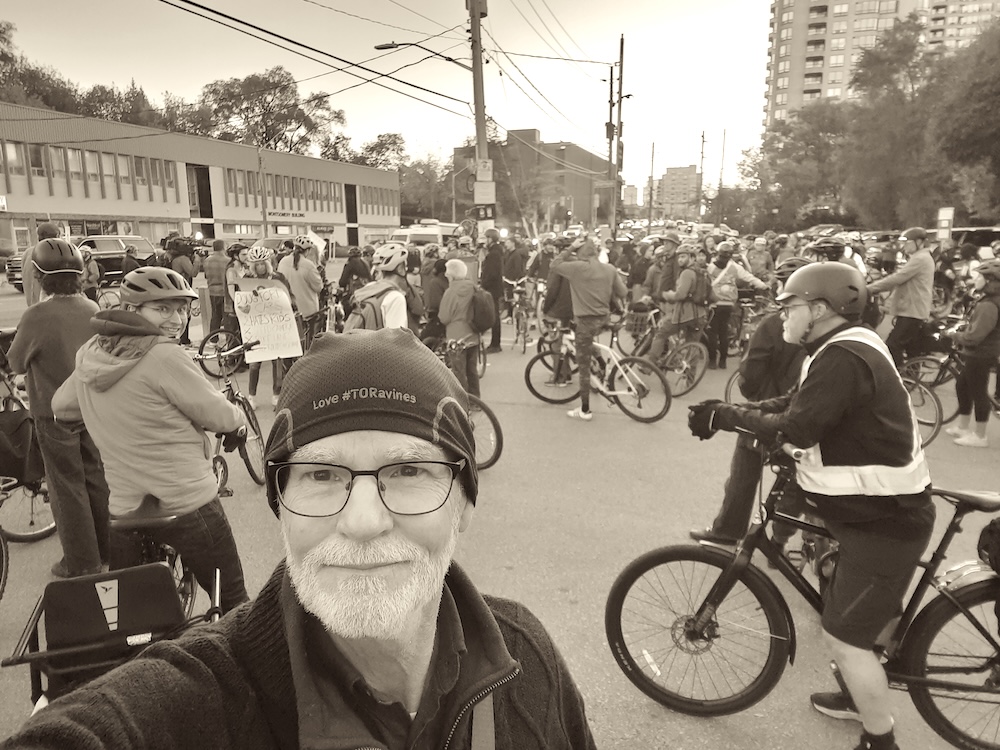
The window on his car door was rolled down as we cycled on Bloor Street West behind him. Our gentle posse was a half-dozen pro-bike-lane supporters attending another protest. The driver wasn’t happy with us, but legally we were in the car vehicle* traffic lane because the adjacent bike lane was, in fact, shut down by traffic pylons in preparation for the lane’s removal per Doug Ford edict. Signs directed bicyclists and drivers to share the road, “SINGLE FILE.”
“I pay my money!” the driver shouted out the window as he gunned past us and into a left-turn lane. It took a beat for that to sink in. What he meant was, he pays taxes for the roads, and thus was entitled to them.
Before we could answer “We pay taxes too!” into his open window, he was too far ahead. However, we said it amongst ourselves, nodding in shared understanding: we pay taxes, biking is a legitimate form of transportation, biking is permitted on roads per the Ontario Highway Traffic Act, bike lanes safely separate out bikes from cars for the sake of both riders and drivers, and bike lanes save lives.
I have been a bike rider in Toronto for more than 40 years. In the early days, that meant plotting complicated routes through side streets and the U of T campus, with sections on the arterials, to get in and out of downtown. Over the years the bike lane network has grown to the point where I enjoy a Copenhagen lifestyle in Toronto — dare I say even better than Copenhagen. We have a car (more on that later), but the vast majority of trips are on foot, by bike or by chauffeured electric vehicle, aka TTC public transit. I want to keep it that way, and make those lifestyle advantages available to more people. Thus my (modest) activism.
Like most bike riders, I ride for many reasons: it’s almost always the fastest way to get around when distances are less than six kilometres or so; it’s the cheapest way to get around; it’s a healthy way to get around; it’s a non-carbon-emitting way to get around; it gives the rider a sense of agency over their life (no one else is in control); and not least, it’s fun! Riders of all ages have that joy of a 10-year-old experiencing freedom. Joy from a wide turn at an intersection; joy from the wind on the face; joy from the little impromptu zig-zag.
Why wouldn’t we want to build out a city that safely offers all this?
The argument that bike lanes cause any kind of meaningful car traffic congestion has been soundly debunked. Just recently, the City of Toronto released data that car traffic congestion has actually improved in the last eight years. In June 2018, Toronto’s Travel Time Index was 2.324 according to City of Toronto numbers (independently assessed) as reported in The Globe and Mail. In July 2026, the most recent period, it had dropped to 1.587. TTI is an international standard ratio based on the question: if travel time is indexed at 1.0 for the least-busy times, how long does it take to travel the same distance at peak times? A score of 2.0 means it takes twice as long.
The last eight years roughly correspond with the City’s 10-year Cycling Network Plan, approved by City Council in 2016, with roll-out and updates in the years since. This period corresponds with the development of the Bloor, University and Yonge Street bike lanes. So if there were more bike lanes, and car traffic congestion actually improved over the same period, what changed?
The City’s chief congestion officer told the Globe the City has increased traffic agents on roads, reduced construction closures and adjusted transit signal priorities. “Construction is typically the biggest contributor to gridlock in the city,” reported the Globe. “That could help explain the recent decline, with major projects on the Gardiner Expressway and Eglinton Avenue wrapping up in recent years.”
The other key source of congestion is… more cars! The answer to congestion isn’t more lanes to accommodate even more cars. The answer is to reduce the number of cars on the road, through better transit, through better land-use planning (the “15-minute community”) and through alternatives such as more biking. Working from home is also part of the solution. The provincial government is actually proposing to add more cars to Toronto’s streets through the pending arrival of self-driving taxis.
I pay attention to photographs of congestion. Where are they taken? On the 401, DVP or Gardiner. On Lake Shore Boulevard. On the approaches to those routes, like the south end of Spadina Avenue at rush hour. No bike lanes on any of those roads.
In winter, it is true there are fewer riders. But I ride every month of the year, as long as the roads are clear and it’s not below -5C, my threshold (which used to be -8C, but at my age, standards are changing). And in Toronto, those conditions are frequently present in the winter. As the Dutch say, there is no such thing as bad weather, just bad clothing choices.
Many motorists say they support bike lanes, just not on arterials like Bloor. Use the secondary roads, they say. News flash: planners look at maps all day long. They have been looking at maps for decades. Bike lanes are already on the secondary roads where it makes sense; for example, a route I use frequently, Argyle Street, parallels Queen Street West and is a great alternative.
I mentioned we own a car. We use it for trips where the bike doesn’t make sense. We drive about 4,000 kilometres a year. Many bikers have cars. As a driver, I appreciate that bikes have their own protected lane. Coming up behind a bicyclist legally in the car lane means slowing down, averting eyes to check mirrors to see if it’s safe to pass, getting stressed because it’s not safe to pass, waiting, waiting, hoping no one gets hurt.
So let’s preserve and improve our bike lane network, for everybody’s sake.
*I’ve added the word “car” to “car vehicle traffic” because it bugs me when “traffic” is used solely to denote motor vehicle traffic, when in fact traffic can mean car, pedestrian, bicycle or other forms of traffic. The use of traffic to mean just car traffic implies the roads are just for cars, no doubt part of a long-standing car-industry propaganda effort. And for the record, a bicycle is defined as a vehicle in the Highway Traffic Act.
Resources:
- Cycle Toronto (non-profit)
- Cycling in Toronto (City of Toronto)
- Friends and Families for Safe Streets (community organization)

